

What Is a VPN and Why Do People Use It With IPTV?
A VPN (Virtual Private Network) encrypts your internet traffic and routes it through a server in another location, masking your IP address and making it appear you’re browsing from a different city or country.
People use VPNs with IPTV for a few reasons — some legitimate, some based on misunderstanding:
- To hide activity from their ISP: Some users worry their internet provider can see they’re streaming IPTV. With a paid service, this concern is largely unfounded — but a VPN does add an extra layer of privacy if you want it.
- To access geo-blocked content: Some IPTV services restrict content by region. A VPN lets you appear to be in a different country to unlock content not available in Canada.
- To avoid ISP throttling: Some Canadian ISPs throttle streaming traffic during peak hours. A VPN can sometimes bypass this, improving stream quality.
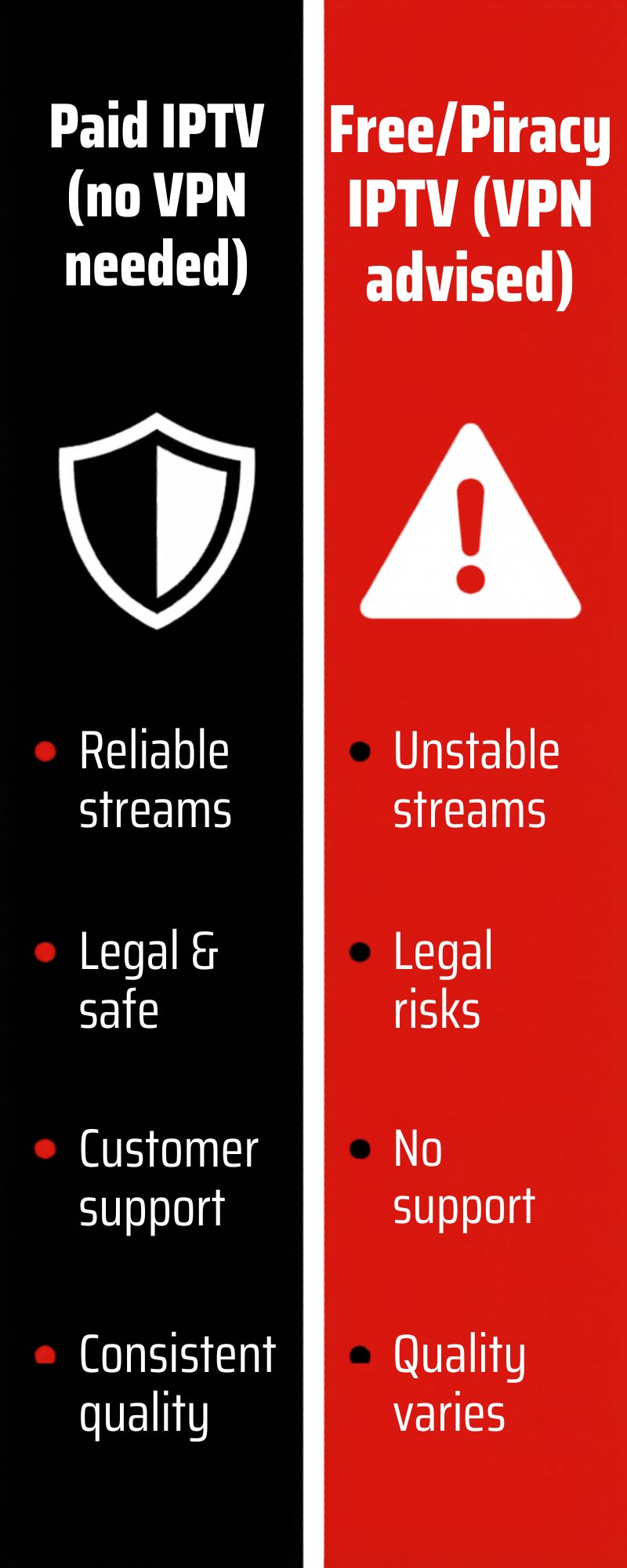
- Because they’re using a piracy-based service: Users of illegal, free IPTV services often use VPNs to avoid detection. This is the main reason VPN + IPTV became so closely associated — but it doesn’t apply to paid subscribers.
Why a VPN Can Actually Hurt Your IPTV Experience
Many Canadians add a VPN to their IPTV setup thinking it makes things better — and then wonder why their streams are buffering. Here’s why VPNs and IPTV often don’t mix well:
- Speed reduction: A VPN encrypts all your traffic and routes it through an extra server. This adds latency and reduces your effective internet speed — sometimes by 20–50%. For 4K streaming that requires 25+ Mbps, this can push you below the threshold.
- Increased buffering: The extra routing adds milliseconds of delay on every data packet. During fast-moving live sports streams, this can translate to visible buffering and freezing — especially during NHL or UFC peak-traffic events.
- Server location mismatch: If your VPN routes traffic through a US server, your Canadian IPTV service may serve you US-region content or flag your account for location anomalies.
- Unnecessary cost: A quality VPN costs $5–$15/month. That money is better spent on a reliable IPTV subscription with anti-buffering infrastructure built in — like MAXIPTV’s 2026 plan.
If your IPTV is buffering, the solution is almost never a VPN — it’s switching to a provider with proper CDN infrastructure. MAXIPTV uses anti-buffering server networks specifically engineered for Canadian peak-hour streaming, so you get zero freezes during playoff games without any VPN.
When Should You Use a VPN With IPTV in Canada?
There are a small number of legitimate scenarios where a VPN makes sense alongside IPTV:
- You’re a Canadian living or travelling abroad: If you’re outside Canada and want to access your Canadian IPTV channels, a Canadian VPN server lets you appear to be at home — unlocking geo-restricted Canadian content.
- Your ISP is throttling streaming: Some Canadian ISPs (Bell, Rogers, Videotron) have been known to throttle streaming traffic during peak hours. A VPN can bypass this throttling if it’s affecting your experience.
- You want general internet privacy: If you use a VPN for all your internet activity for broader privacy reasons — not specifically for IPTV — that’s a personal choice. Just be aware of the speed trade-off on streams.
Instead of adding the complexity and cost of a VPN, choose an IPTV provider that already solves these problems. MAXIPTV’s servers are optimized for Canadian ISP networks — including Bell and Rogers environments — so throttling and buffering are handled at the infrastructure level. See why MAXIPTV is Canada’s best solution.
Is IPTV Legal in Canada Without a VPN?
Yes — and this is the most important point. Using a paid IPTV subscription in Canada for personal home viewing is legal, and does not require a VPN to stay legal.
Canadian law and CRTC enforcement focus on commercial piracy operations — businesses that distribute stolen broadcast signals at scale. Individual subscribers of paid services like MAXIPTV are not the target of any Canadian enforcement action, with or without a VPN.
The legal risk with IPTV in Canada comes from the type of service, not from whether you use a VPN. A VPN does not make an illegal service legal. The solution is to use a legitimate paid service — not to add a VPN on top of a problematic one. Read our full IPTV legal guide for Canada.
Frequently Asked Questions
Do I need a VPN for IPTV in Canada?
Will a VPN stop my IPTV from buffering?
Can my ISP see that I’m using IPTV in Canada?
Does a VPN make illegal IPTV legal in Canada?
What internet speed do I need for IPTV without a VPN?
How do I access Canadian IPTV while travelling abroad?
Related Guides
Try MAXIPTV Free Today
Legal. Fast. No VPN required. No credit card for the trial.
15,000+ channels · 4K Ultra HD · NHL · TSN · UFC · From $12.99/mo
Instant activation · Works on all devices · Cancel anytime · No contracts